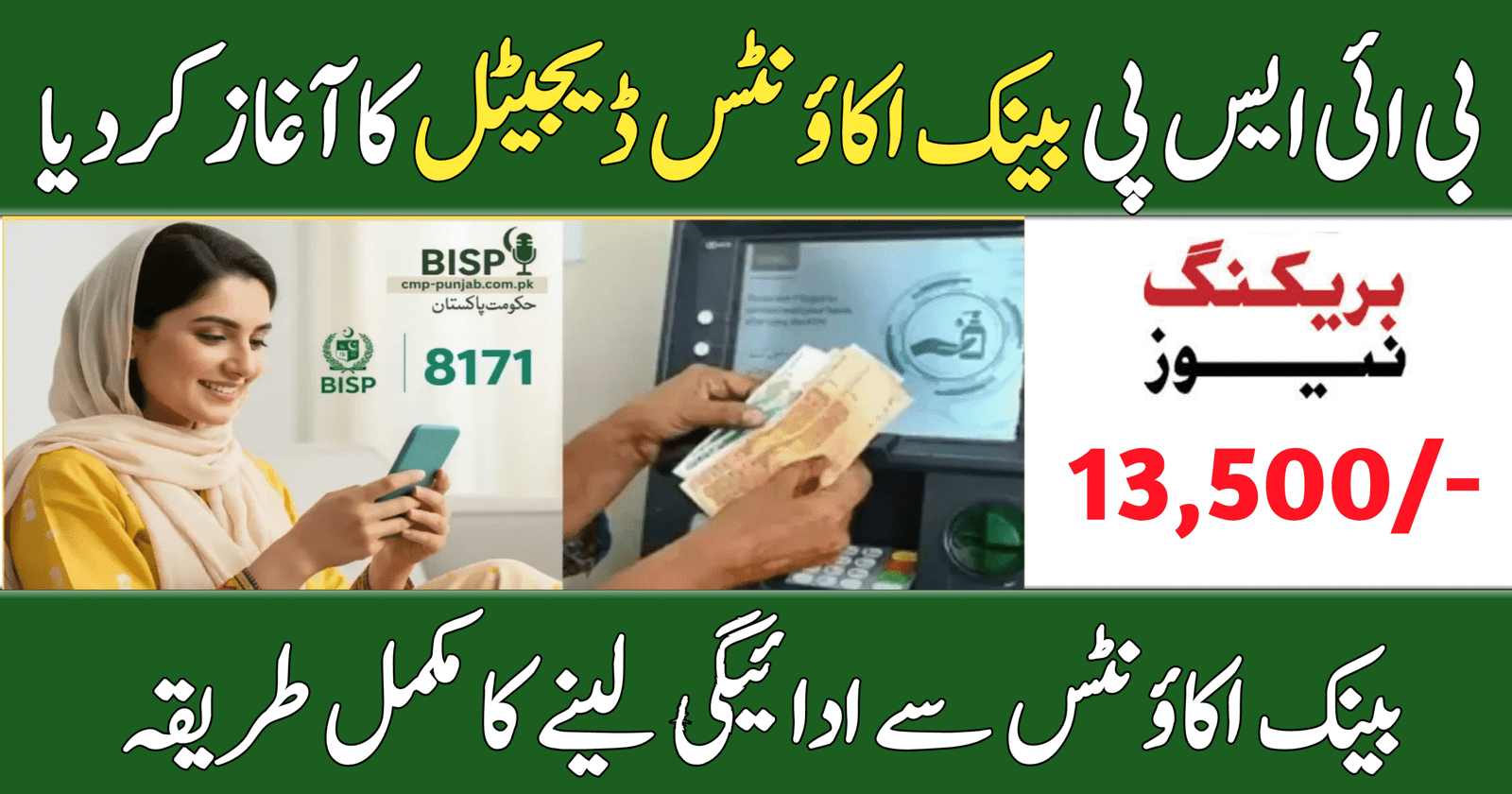
The BISP Bank Accounts Ready for Digital Transactions initiative is a major step toward financial inclusion in Pakistan. The government has successfully opened 10 million (one crore) bank accounts for beneficiaries of the Benazir Income Support Programme (BISP). This move is designed to give women across the country direct access to their stipends without depending on agents or facing unfair deductions.
However, there is one important point to remember: every withdrawal will carry a bank fee of Rs 100 to Rs 200. While this may feel like an extra burden, the government believes that the overall benefits of transparency, safety, and dignity are far greater.

Table of Contents
Why BISP Bank Accounts Were Introduced
For years, beneficiaries complained about agent deductions, limited payment sites, and long queues. To solve these issues, the government decided to link stipends directly with bank accounts.
The main reasons for this shift include:
- Reducing corruption and middleman exploitation.
- Making financial support transparent and modern.
- Promoting digital inclusion for poor women.
- Achieving the Prime Minister’s ambitious target of 10 million accounts in just four months.
It is worth noting that these accounts remain inactive until the first withdrawal. Once a woman withdraws her stipend for the first time, her account will become fully functional for future use.

How Beneficiaries Will BISP Withdraw Money
The new process is designed to be simple and user-friendly. Beneficiaries no longer need to wait at campsites or rely on agents. Instead, they can directly visit their bank or ATM.
- Visit any branch of the bank linked with BISP.
- Show your original CNIC at the counter.
- Withdraw your stipend from the teller or ATM.
- The first withdrawal will activate your account permanently.
- Collect the printed receipt for safety and record-keeping.
This process not only increases security but also restores dignity, as women are now treated as proper banking customers.

Bank Charges for BISP Payment Withdrawals
With the introduction of these accounts, banks have applied their standard service charges. Every withdrawal will cost between Rs 100 and Rs 200.
- These charges are deducted by the bank itself, not by agents.
- The fee helps banks cover costs of ATM services, branch operations, and transaction security.
- The amount is standard across banks and is necessary to maintain long-term services.
Table: Quick Information
| Category | Details |
| Total Accounts | 10 million (one crore) |
| Activation | On first withdrawal with CNIC |
| Withdrawal Fee | Rs 100–200 per transaction |
| Deduction By | Bank (not agents) |
| Banks Onboard | 6 banks (more joining soon) |
| OneLink Integration | In progress, 6 months to complete |
Progress of Banks and Digital Integration
At present, six major banks are managing the BISP accounts. These banks are working on connecting their systems with OneLink, which will allow beneficiaries to withdraw money from any ATM or bank branch in Pakistan.
The integration process is expected to finish in the next six months. After that, beneficiaries may also get access to:

- Digital wallets
- Small savings options
- Remittance deposits from family members
This will help women go beyond stipend collection and become part of the wider financial system.
Benefits of the BISP Payment New System
The introduction of BISP bank accounts comes with several long-term advantages, especially for women in rural areas:
- Direct control over money without middlemen.
- Secure receipts from official banking channels.
- Future options to save money or use mobile wallets.
- Increased financial dignity and independence.
- Access to remittances from inside or outside Pakistan.
This step is not just about receiving aid—it is about financial empowerment for millions of women.
Challenges That Remain
Despite the progress, a few challenges remain:
- Many women in villages are unfamiliar with ATMs and digital banking.
- Some rural areas have limited access to bank branches.
- The withdrawal charges of Rs 100–200 may feel heavy for women relying only on stipends.
To overcome these issues, the government and partner banks are planning awareness campaigns. Training sessions will help women understand how to use ATMs safely, identify fraud risks, and manage their accounts independently.
Table: Benefits vs Challenges
| Benefits | Challenges |
| Direct control over funds | Lack of digital literacy in villages |
| Transparency and no agent deductions | Limited bank branches in rural areas |
| Secure receipts for transactions | Withdrawal charges Rs 100–200 |
| Access to remittances & savings | Initial difficulty in using ATMs |
| Dignity as proper bank customers | Need for awareness campaigns |
Final Thoughts
The opening of one crore BISP bank accounts is a turning point for Pakistan’s welfare system. For the first time, millions of women will enjoy direct, agent-free, and secure access to their stipends. Although the withdrawal fee of Rs 100–200 may be seen as a challenge, the long-term benefits of transparency, independence, and financial dignity outweigh this cost.
As more banks join and digital literacy improves, these women will not just be recipients of aid but also participants in Pakistan’s financial system. This marks the beginning of a new era of inclusive and accountable welfare distribution in the country.